How to Spot a Flood Car in Houston Before You Buy
|
How to Spot a Flood Car in Houston Before You Buy
Houston leads the entire United States in flood-damaged cars on the road. Right now there are an estimated 29,000 flood vehicles circulating in the Houston metro alone, according to CarFax – more than any other city in America. Spotting one before you buy requires more than a test drive and a history report. Here is exactly what to check.
Houston’s used car market is one of the most active in the country. It’s also one of the most dangerous if you don’t know what you’re looking at.
Hurricane Harvey alone flooded up to 500,000 vehicles in the Houston area. Roughly half of all flooded vehicles in the US get cleaned up and put back on the market, according to CarFax. Add in post-2022 hurricanes and the 45,000 additional flood-damaged vehicles from mid-2025 storms across Texas – and the inventory risk is real.
A clean CarFax report and a nice-looking interior are not enough. Here’s how to avoid buying a flood car in Houston.
Why Houston Has More Flood Cars Than Anywhere Else in the US
The numbers aren’t close. After Hurricane Ian in 2022, CarFax confirmed Houston had nearly 32,000 flood-damaged vehicles in its used car market – more than Miami, Tampa, or any other metro in the country. The 2024 hurricane season added 29,000 more. And mid-2025 storms in Texas added yet another wave.
Flood cars don’t stay where they flood. Sellers move them across state lines deliberately to reset the paper trail. A vehicle flooded in Pearland or Baytown may show up for sale in San Antonio, Austin, or out of state entirely – then find its way back to a Houston lot after title-washing has cleaned its history.
Texas law requires the words Flood Damage to appear on a vehicle title when water damage has been reported, as noted by the Texas Attorney General’s office. But title washing – re-registering the vehicle in a state with weaker disclosure laws – removes that protection entirely. A clean Texas title is not proof the car was never flooded.
What to Check Inside the Car
Start in the cabin before you open the hood or look underneath. Your nose is the first instrument. Open the door and stand back for a few seconds before getting in.
A musty, damp, or mildew smell that won’t go away is the single most reliable flood indicator. Sellers know this. An overwhelming air freshener in an older car is almost always masking something.
Beyond the smell, here’s what to check inside:
Brand new carpet or upholstery in a car that’s 5+ years old is a red flag, not a selling point – it often means the original was replaced to hide water damage
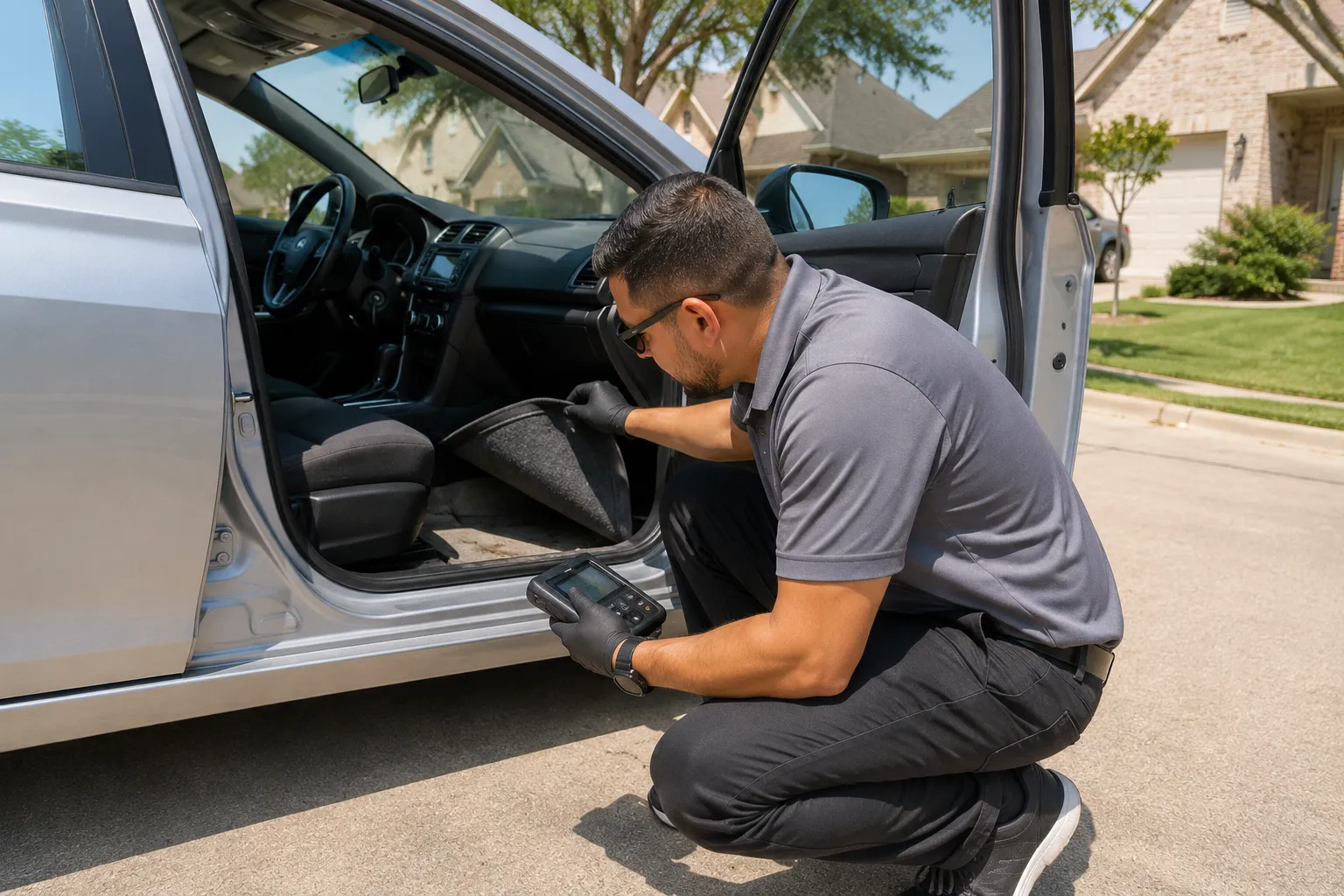
Lift every floor mat and press the carpet underneath with your fingers – flood cars often retain moisture for months, especially in humid Houston heat
Look for tide lines or water stains on the lower door panels, sill plates, and under the front seats
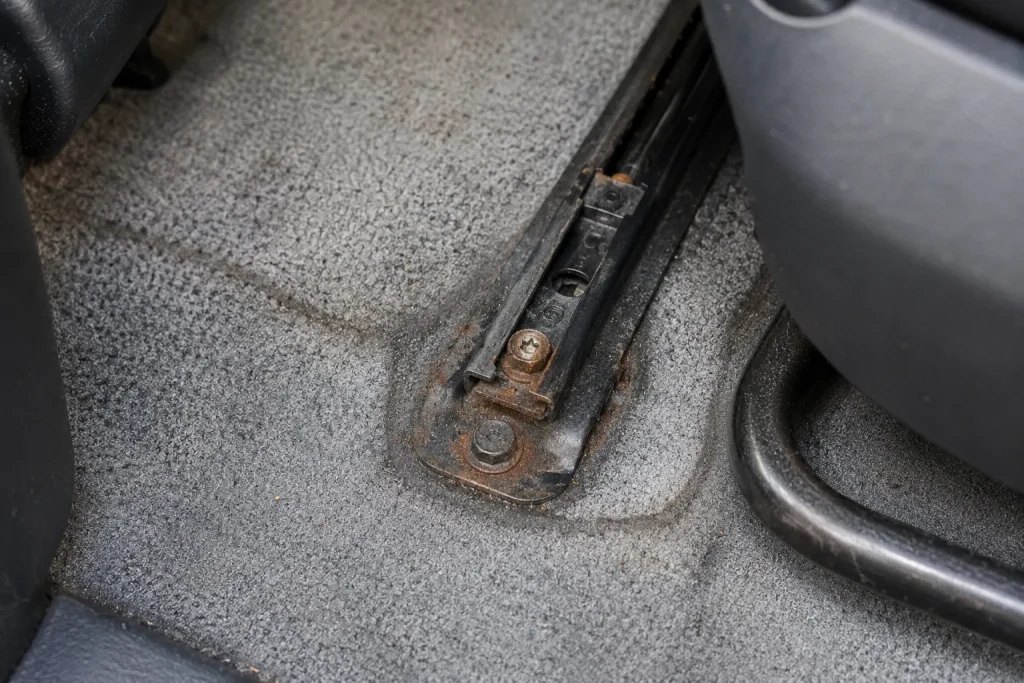
Check the seat rail bolts and mounting hardware for rust – these metal components are never normally exposed to water, and corrosion here is a strong indicator
Open the glove compartment and look in the corners for dried silt, grit, or a watermark ring
Check the trunk floor under the cargo mat and remove the spare tire – water pooling under the spare is a classic flood tell
Look at the headliner for staining or separation from the roof panel – floodwater often wicks up into the ceiling
Flood Damage Warning Signs by Location
Every area of the vehicle tells part of the story. Use this as your walk-around guide on any used car purchase in Houston.
| Location | What to Look For | Red Flag Level |
| Interior cabin | Musty or moldy smell, fogged instrument cluster, strong air freshener masking odor | Critical |
| Carpet and floor mats | Water stains, tide lines, unusually new carpet in an older car, moisture when carpet is pressed | Critical |
| Seat rails and door hinges | Rust or corrosion on metal components that are never normally exposed to water | High |
| Dashboard and console | Rust on screws, water residue or dried silt behind trim panels, gritty residue in crevices | High |
| Engine bay | Mud or silt deposits around starter motor, behind wiring harness, water line on engine block | Critical |
| Exterior lights | Condensation, water pooling, or fog inside headlight or taillight housings with no visible cracks | Medium |
| Undercarriage | Rust pattern inconsistent with vehicle age, freshly sprayed undercoating, tool marks on drain plugs | Critical |
| Title and documents | No flood branding despite flood history, recently re-registered from a hurricane-affected state | Critical |
The undercarriage is the hardest area for sellers to fully clean and disguise. Freshly applied undercoating on a car that’s only a few years old is worth questioning – legitimate undercoating is usually done at the factory, not after the fact.
Drain plug tool marks are one of the clearest tells. When a car is flooded, water is drained through plugs located on the floor pan. Evidence of recent tool use on those plugs, combined with other indicators, builds a strong case.
Why a Clean CarFax Report Is Not Enough in Houston
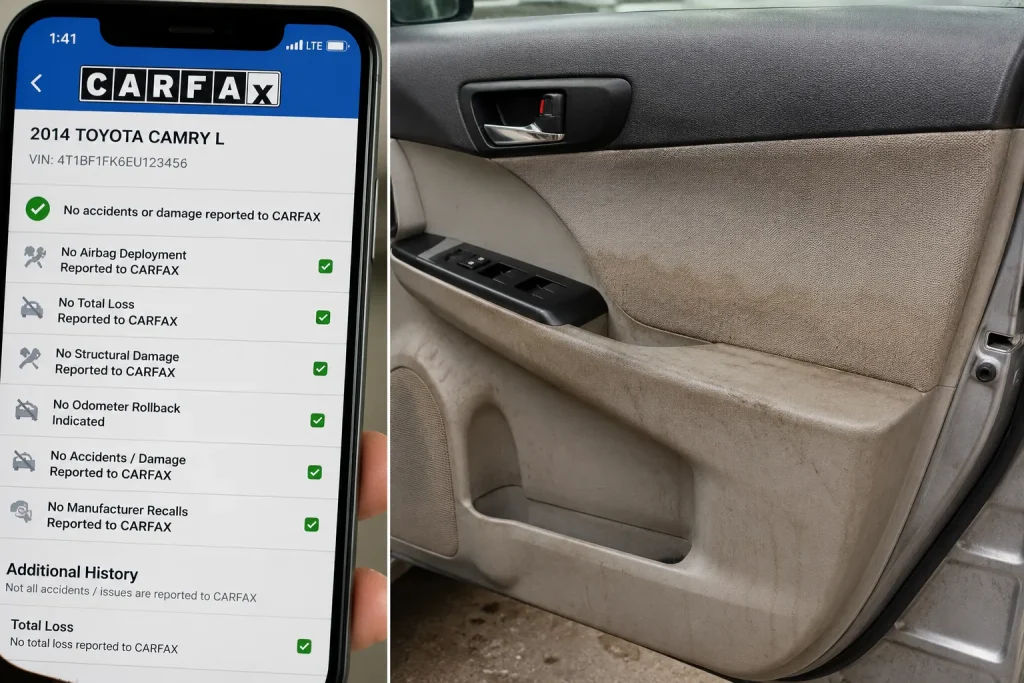
CarFax and AutoCheck capture flood damage when it’s been officially reported – through an insurance claim, a salvage title, or a state title branding. They miss a significant portion of flood cars because much of the damage never gets officially reported.
Cash repairs don’t show up. Private sales don’t trigger disclosures. And title washing removes the flood branding entirely. We regularly perform inspections on Houston vehicles with spotless vehicle history reports that turn out to have clear flood indicators throughout the cabin and undercarriage.
The 1-in-6 rule applies here too. Industry data shows approximately 1 in 6 used vehicles has accident damage that was never reported to CarFax. For flood damage, the miss rate is even higher because so many Harvey vehicles changed hands privately before any official reporting could occur.
The Check That Catches What Your Eyes Miss
A physical walk-around catches a lot. But the pre purchase auto inspection goes several steps further – particularly in Houston where flood cars are a known market risk on every single transaction.
The OBD-II full-module scan is the part most buyers never think to ask about. Flood cars often have a specific pattern of stored codes across the ABS module, SRS airbag system, and body control module – electrical faults caused by water infiltration that the seller can temporarily clear but that return once the car is driven. The readiness monitors tell you whether codes were recently erased.
The lift check examines the undercarriage, frame rails, and floor pan in a way no walk-around can match. Rust patterns, drain plug condition, and undercoating freshness are all visible from underneath in a way they simply aren’t from street level.
For electric vehicles in particular, flood damage creates an entirely different and more serious risk profile. A electric vehicle inspection houston evaluates battery health and high-voltage system integrity – areas where flood exposure can create safety hazards that don’t show up for months.
If a seller claims repairs were already made after a flood event, a follow-up inspection for $99 lets you verify the work was actually done before committing to the purchase.
Frequently Asked Questions
How do I check if a used car in Houston was damaged by Hurricane Harvey?
Run a vehicle history report and check for flood branding on the title. Texas law requires the words Flood Damage on any title branded for water damage. But many Harvey vehicles have had their titles washed through out-of-state resales. A physical pre purchase inspection checking carpet moisture, undercarriage rust patterns, wire harness corrosion, and engine bay silt deposits is the most reliable way to catch a Harvey flood car regardless of what the title says.
Does Texas law require sellers to disclose flood damage?
Yes. Under Texas law, a vehicle with flood damage must have Flood Damage on its title. The Texas Attorney General’s office warns that failure to disclose may be a violation of law. But this protection only applies if the flood was reported and the title was properly branded. Title washing – re-registering in another state with weaker disclosure laws – is a known workaround that bypasses this requirement entirely.
Will a vehicle history report show flood damage?
Sometimes. CarFax and AutoCheck capture flood damage when it has been officially reported through insurance claims or title brandings. Cash repairs, private resales, and out-of-state title washing frequently go unrecorded. We regularly find flood indicators on Houston vehicles with completely clean CarFax reports. A history report is a useful first step – it is not a substitute for a physical inspection.
What makes flood-damaged cars so dangerous long-term?
Flood cars rot from the inside out. Water infiltrates the wiring harness, airbag systems, ABS module, and other safety-critical electronics – often causing failures months after the car looks and drives fine. Mold and bacteria build up in the ventilation system, seat cushions, and carpet backing. Structural rust progresses unseen beneath freshly applied undercoating. Most flood car problems don’t announce themselves at the point of sale.
How do I book a flood car inspection in Houston?
Call (346) 644-6168 or order an inspection online at prepurchaseautoinspectionsllc.com. We come to the vehicle’s location anywhere in the Houston metro – the dealer lot, a private seller’s driveway in Katy or Sugar Land, or a Carvana delivery point. Same-day scheduling is available on most requests. Every standard pre purchase inspection includes a dedicated flood damage check.
Don’t Guess on a Flood Car. Get It Inspected.
Pre Purchase Auto Inspections LLC comes to the vehicle – anywhere in Houston, Katy, Sugar Land, Pearland, Pasadena, or The Woodlands. We check every flood indicator and deliver a same-day written report.
(346) 644-6168 | order an inspection online
Get a Pre Purchase Auto Inspection Today